Provides utilities for generating synthetic string datasets for benchmark testing. More...
#include <string>#include <vector>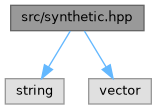
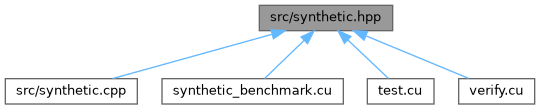
Go to the source code of this file.
Functions | |
| std::string | get_random_word (size_t length) noexcept |
| Generates a random string of specified length. | |
| std::vector< std::string > | get_random_words (size_t length, size_t num_words, double mean_lcp_length) noexcept |
| Generates a collection of random strings with controlled commonality. | |
Detailed Description
Provides utilities for generating synthetic string datasets for benchmark testing.
This file contains functions for generating random strings with controllable properties such as length, quantity, and shared prefix length. These synthetic datasets are used for benchmarking various trie implementations under controlled conditions.
The implementation uses a diverse alphabet containing lowercase letters, uppercase letters, digits, and special characters to generate strings with randomized content.
Definition in file synthetic.hpp.
Function Documentation
◆ get_random_word()
|
noexcept |
Generates a random string of specified length.
Creates a string using characters from a predefined alphabet containing lowercase letters, uppercase letters, digits, and special characters. Each character is selected independently using a uniform random distribution.
The implementation uses C++'s standard random number facilities (std::mt19937) with either a random seed or an optional fixed seed for reproducible results.
- Parameters
-
length The desired length of the random string.
- Returns
- std::string A newly generated random string.
- See also
- get_random_words()
Generates a random string of specified length.
Generates a random string of specified length using characters from the ALPHABET. The implementation uses a static random number generator (std::mt19937) initialized with either a random seed from std::random_device or an optional fixed seed for reproducible results.
Each character in the string is selected independently using a uniform distribution over the entire alphabet, ensuring equal probability for all characters.
- Parameters
-
length The desired length of the random string.
- Returns
- std::string A newly generated random string of the specified length.
- See also
- synthetic.hpp for the function declaration and additional documentation.
Definition at line 59 of file synthetic.cpp.
◆ get_random_words()
|
noexcept |
Generates a collection of random strings with controlled commonality.
Creates a set of random strings where each string has a specified length, and pairs of strings are likely to share a common prefix of a length drawn from a Poisson distribution with the specified mean. To ensure uniqueness, each string includes a unique signature at the end.
The generated dataset has the following specific properties:
- Each string has the exact same length (specified by 'length' parameter)
- Each string has a unique signature at the end to ensure uniqueness
- Strings share common prefixes with lengths following a Poisson distribution
The algorithm first generates random words, then adds unique signatures, and finally creates controlled common prefixes between the strings. The unique signatures are created by encoding the string's index as a base-N number, where N is the alphabet size. The length of this signature is calculated to ensure all strings can have a unique value.
This function is particularly useful for benchmarking trie data structures with controlled LCP (Longest Common Prefix) distributions.
- Parameters
-
length The length of each string to generate. num_words The number of strings to generate. mean_lcp_length The mean length of the Longest Common Prefix (LCP) between strings.
- Returns
- std::vector<std::string> A vector containing the generated strings.
- See also
- get_random_word()
Generates a collection of random strings with controlled commonality.
Generates a collection of random strings with controlled Longest Common Prefix (LCP) properties. The implementation follows these steps:
- Generate num_words random strings of the specified length.
- Calculate the minimum signature length needed to ensure uniqueness.
- Add a unique signature at the end of each string by encoding its index.
- For each string, generate a random LCP length from a Poisson distribution.
- Replace part of each string to create the desired LCP pattern while preserving the unique signature.
The Poisson distribution ensures that the LCP lengths follow a realistic distribution with the specified mean, while the unique signatures guarantee that all strings remain distinct regardless of the LCP modifications.
- Parameters
-
length The length of each string to generate. num_words The number of strings to generate. mean_lcp_length The mean length of the Longest Common Prefix between strings.
- Returns
- std::vector<std::string> A vector containing the generated strings.
- See also
- synthetic.hpp for the function declaration and additional documentation.
Definition at line 100 of file synthetic.cpp.