Provides utility functions and classes for CUDA operations. More...
#include <bit>#include <cstddef>#include <cstdint>#include <cstdio>#include <cuda_runtime.h>#include <limits>
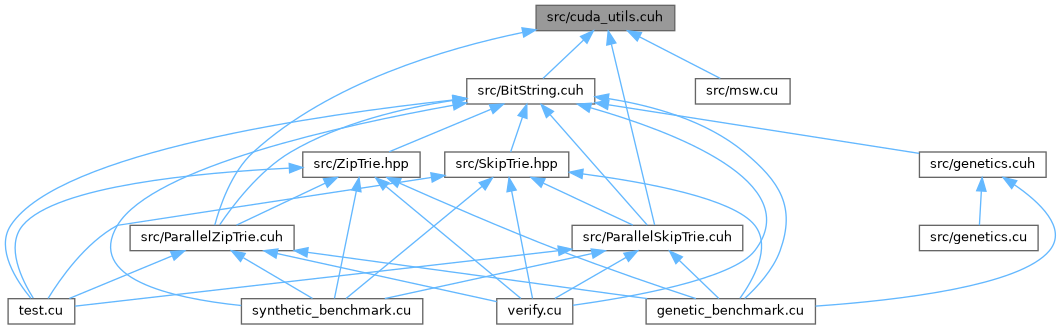
Go to the source code of this file.
Classes | |
| class | CudaTimer |
| A simple CUDA timer class using CUDA events. More... | |
Macros | |
| #define | BLOCKS 64 |
| Default number of blocks to launch in CUDA kernels. | |
| #define | THREADS 1024 |
| Default number of threads per block in CUDA kernels. | |
| #define | gpuErrchk(ans) { gpuAssert(ans, __FILE__, __LINE__); } |
| Macro to check CUDA API calls for errors. | |
Functions | |
| void | gpuAssert (cudaError_t code, const char *file, int line, bool abort=true) |
| Asserts if a CUDA error code indicates failure. | |
| __host__ size_t | host_fast_log2 (size_t n) |
| Computes the floor of log base 2 for a host integer using std::bit_width. | |
| __host__ size_t | host_fast_log2_ceil (size_t n) |
| Computes the ceiling of log base 2 for a host integer using std::bit_width. | |
| __device__ __forceinline__ size_t | device_fast_log2 (size_t n) |
| Computes the floor of log base 2 for a device integer using count leading zeros. | |
| __device__ __forceinline__ size_t | device_fast_log2_ceil (size_t n) |
| Computes the ceiling of log base 2 for a device integer using count leading zeros. | |
| template<typename T > | |
| T * | alloc_to_device (size_t size) |
| Allocates memory on the CUDA device. | |
| template<typename T > | |
| T * | copy_to_device (T *d_arr, const T *arr, size_t size) |
| Copies data from host memory to existing device memory. | |
| template<typename T > | |
| T * | copy_to_device (const T *arr, size_t size) |
| Allocates device memory and copies data from host memory to it. | |
| template<typename T > | |
| T * | memset_within_device (T *d_arr, size_t size, int value) |
| Sets a region of device memory to a specific byte value. | |
| template<typename T > | |
| T * | memset_to_device (size_t size, int value) |
| Allocates device memory and sets it to a specific byte value. | |
| template<typename T > | |
| T * | copy_within_device (T *d_dest, const T *d_src, size_t size) |
| Copies data from one device memory location to another. | |
| void | synchronize_device () |
| Synchronizes the host thread with the default CUDA device stream. | |
| template<typename T > | |
| T * | copy_from_device (const T *d_arr, size_t size) |
| Allocates host memory and copies data from device memory to it. | |
| template<typename T > | |
| void | device_free (T *d_arr) |
| Frees memory on the CUDA device. | |
| __device__ __forceinline__ size_t | get_tid () |
| Gets the global thread ID within a CUDA kernel launch. | |
| constexpr size_t | get_num_threads () |
| Gets the total number of threads in the kernel launch (compile-time). | |
Variables | |
| static constexpr bool | CHECK_CUDA_ERRORS = false |
| Compile-time flag to enable/disable CUDA error checking via gpuErrchk/gpuAssert. | |
Detailed Description
Provides utility functions and classes for CUDA operations.
This file includes common CUDA helper functions, error checking macros, memory management wrappers, a timer class, and mathematical utilities for both host and device code.
Definition in file cuda_utils.cuh.
Macro Definition Documentation
◆ BLOCKS
| #define BLOCKS 64 |
Default number of blocks to launch in CUDA kernels.
Definition at line 21 of file cuda_utils.cuh.
◆ gpuErrchk
Macro to check CUDA API calls for errors.
Calls gpuAssert to check the result of a CUDA API call.
- Parameters
-
ans The result of the CUDA API call (cudaError_t).
Definition at line 35 of file cuda_utils.cuh.
◆ THREADS
| #define THREADS 1024 |
Default number of threads per block in CUDA kernels.
Definition at line 26 of file cuda_utils.cuh.
Function Documentation
◆ alloc_to_device()
Allocates memory on the CUDA device.
Wrapper around cudaMalloc with optional error checking.
- Template Parameters
-
T The data type of the array elements.
- Parameters
-
size The number of elements of type T to allocate.
- Returns
- T* Pointer to the allocated device memory.
- Note
- Uses
gpuErrchkifCHECK_CUDA_ERRORSis true.
Definition at line 190 of file cuda_utils.cuh.
◆ copy_from_device()
Allocates host memory and copies data from device memory to it.
Wrapper around cudaMemcpy (DeviceToHost) with optional error checking. Allocates host memory using new[].
- Template Parameters
-
T The data type of the array elements.
- Parameters
-
d_arr Pointer to the source device memory. size The number of elements of type T to copy.
- Returns
- T* Pointer to the newly allocated host memory containing the copied data.
- Note
- The caller is responsible for freeing the returned host memory using
delete[]. -
Uses
gpuErrchkifCHECK_CUDA_ERRORSis true.
Definition at line 359 of file cuda_utils.cuh.
◆ copy_to_device() [1/2]
Allocates device memory and copies data from host memory to it.
Combines allocation (alloc_to_device) and copy (copy_to_device).
- Template Parameters
-
T The data type of the array elements.
- Parameters
-
arr Pointer to the source host memory. size The number of elements of type T to allocate and copy.
- Returns
- T* Pointer to the newly allocated and populated device memory.
- Note
- Uses
gpuErrchkindirectly ifCHECK_CUDA_ERRORSis true.
Definition at line 245 of file cuda_utils.cuh.
◆ copy_to_device() [2/2]
Copies data from host memory to existing device memory.
Wrapper around cudaMemcpy (HostToDevice) with optional error checking.
- Template Parameters
-
T The data type of the array elements.
- Parameters
-
d_arr Pointer to the destination device memory (must be pre-allocated). arr Pointer to the source host memory. size The number of elements of type T to copy.
- Returns
- T* The pointer to the destination device memory (
d_arr).
- Note
- Uses
gpuErrchkifCHECK_CUDA_ERRORSis true.
Definition at line 219 of file cuda_utils.cuh.
◆ copy_within_device()
Copies data from one device memory location to another.
Wrapper around cudaMemcpy (DeviceToDevice) with optional error checking.
- Template Parameters
-
T The data type of the array elements.
- Parameters
-
d_dest Pointer to the destination device memory. d_src Pointer to the source device memory. size The number of elements of type T to copy.
- Returns
- T* The pointer to the destination device memory (
d_dest).
- Note
- Uses
gpuErrchkifCHECK_CUDA_ERRORSis true.
Definition at line 311 of file cuda_utils.cuh.
◆ device_fast_log2()
| __device__ __forceinline__ size_t device_fast_log2 | ( | size_t | n | ) |
Computes the floor of log base 2 for a device integer using count leading zeros.
- Parameters
-
n The input value. Must be greater than 0.
- Returns
- size_t The largest integer
ksuch that 2^k <= n.
- Note
- Device code only. Uses
__clzll(count leading zeros for long long).
Definition at line 103 of file cuda_utils.cuh.
◆ device_fast_log2_ceil()
| __device__ __forceinline__ size_t device_fast_log2_ceil | ( | size_t | n | ) |
Computes the ceiling of log base 2 for a device integer using count leading zeros.
- Parameters
-
n The input value. Must be greater than 0.
- Returns
- size_t The smallest integer
ksuch that 2^k >= n.
- Note
- Device code only. Uses
__clzll(count leading zeros for long long).
Definition at line 118 of file cuda_utils.cuh.
◆ device_free()
Frees memory on the CUDA device.
Wrapper around cudaFree with optional error checking.
- Template Parameters
-
T The data type of the array elements (used for pointer type).
- Parameters
-
d_arr Pointer to the device memory to free.
- Note
- Uses
gpuErrchkifCHECK_CUDA_ERRORSis true.
Definition at line 385 of file cuda_utils.cuh.
◆ get_num_threads()
Gets the total number of threads in the kernel launch (compile-time).
Calculates the total number of threads based on the predefined BLOCKS and THREADS macros.
- Returns
- constexpr size_t The total number of threads.
- Note
- This is a
constexprfunction, evaluated at compile time.
Definition at line 424 of file cuda_utils.cuh.
◆ get_tid()
| __device__ __forceinline__ size_t get_tid | ( | ) |
Gets the global thread ID within a CUDA kernel launch.
Calculates the unique ID for the current thread across all blocks in the grid. Assumes a 1D grid and 1D block configuration.
- Returns
- size_t The global thread identifier.
- Note
- Device code only.
Definition at line 406 of file cuda_utils.cuh.
◆ gpuAssert()
Asserts if a CUDA error code indicates failure.
Checks the provided CUDA error code. If it's not cudaSuccess, it prints an error message including the error string, file name, and line number. If abort is true, it terminates the program.
- Parameters
-
code The CUDA error code to check. file The source file where the check occurs (FILE). line The line number where the check occurs (LINE). abort If true (default), exits the program upon error.
Definition at line 49 of file cuda_utils.cuh.
◆ host_fast_log2()
Computes the floor of log base 2 for a host integer using std::bit_width.
- Parameters
-
n The input value. Must be greater than 0.
- Returns
- size_t The largest integer
ksuch that 2^k <= n.
- Note
- Host code only.
Definition at line 74 of file cuda_utils.cuh.
◆ host_fast_log2_ceil()
Computes the ceiling of log base 2 for a host integer using std::bit_width.
- Parameters
-
n The input value. Must be greater than 0.
- Returns
- size_t The smallest integer
ksuch that 2^k >= n.
- Note
- Host code only.
Definition at line 88 of file cuda_utils.cuh.
◆ memset_to_device()
Allocates device memory and sets it to a specific byte value.
Combines allocation (alloc_to_device) and memory set (memset_within_device).
- Template Parameters
-
T The data type of the array elements.
- Parameters
-
size The number of elements of type T to allocate and set. value The integer byte value to set (e.g., 0).
- Returns
- T* Pointer to the newly allocated and initialized device memory.
- Note
- Uses
gpuErrchkindirectly ifCHECK_CUDA_ERRORSis true.
Definition at line 291 of file cuda_utils.cuh.
◆ memset_within_device()
Sets a region of device memory to a specific byte value.
Wrapper around cudaMemset with optional error checking.
- Template Parameters
-
T The data type of the array elements (used for size calculation).
- Parameters
-
d_arr Pointer to the device memory region to set. size The number of elements of type T in the region. value The integer byte value to set (e.g., 0).
- Returns
- T* The pointer to the device memory region (
d_arr).
- Note
- Uses
gpuErrchkifCHECK_CUDA_ERRORSis true.
Definition at line 265 of file cuda_utils.cuh.
◆ synchronize_device()
|
inline |
Synchronizes the host thread with the default CUDA device stream.
Waits until all preceding commands in the default stream have completed. Wrapper around cudaDeviceSynchronize with optional error checking.
- Note
- Uses
gpuErrchkifCHECK_CUDA_ERRORSis true.
Definition at line 333 of file cuda_utils.cuh.
Variable Documentation
◆ CHECK_CUDA_ERRORS
Compile-time flag to enable/disable CUDA error checking via gpuErrchk/gpuAssert.
- Note
- Set to
trueto enable runtime checks (potentially slower),falseto disable them.
Definition at line 66 of file cuda_utils.cuh.